Welcome to the Club
 In the world of aviation there are a pair of clubs in which no aviator seeks membership. The initiation fee is not some fantastic amount of money, but instead survival. The ranks of the Caterpillar Club include those who “hit the silk” and used a parachute to escape from an airplane and the Goldfish Club counts as members those who survived a water landing.
The Caterpillar Club formed at Wright Field in Dayton, OH, in October 1922, after Army Air Service First Lieutenant Harold R. Harris bailed out of an airplane after it went out of control. An engineer on the base, Milton H. St. Clair, and two local journalists, Verne Timmerman and Maurice Hutton, thought that with more such escapes inevitable, there should some recognition. The name of the club derived from the fact that parachutes were made of silk produced from the cocoon of a caterpillar.
“So as you see enrollment into the famous Caterpillar Club is never contemplated,” a reporter wrote in the Evansville Journal in 1930. “It is open to novice and veteran, the bungler and the expert. Although unanticipated and I dare say unaspired … these self-deliverers find it rather refreshing to cushion themselves in this ‘society of saved men.’” At the time, the article noted 271 members with 12 of them having made more than one successful bailout. Among them was Charles Lindbergh and then-Captain Ira Eaker, future commander of the Eighth Air Force during World War II. The numbers exploded during the wide-ranging global war, which also spawned another club.
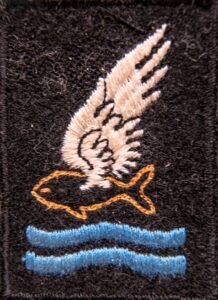 Founded in Great Britain in 1942, the Goldfish Club welcomed its first members after Royal Air Force aircrew had survived using rubber dinghies and life rafts manufactured by P.B. Cow visited the company. Hearing their stories, Chief Draftsman C.A. “Robbie” Robertson created the club, continuing its operation even after leaving the company after the war. The name derived from “gold for the value of life and fish for the sea.”
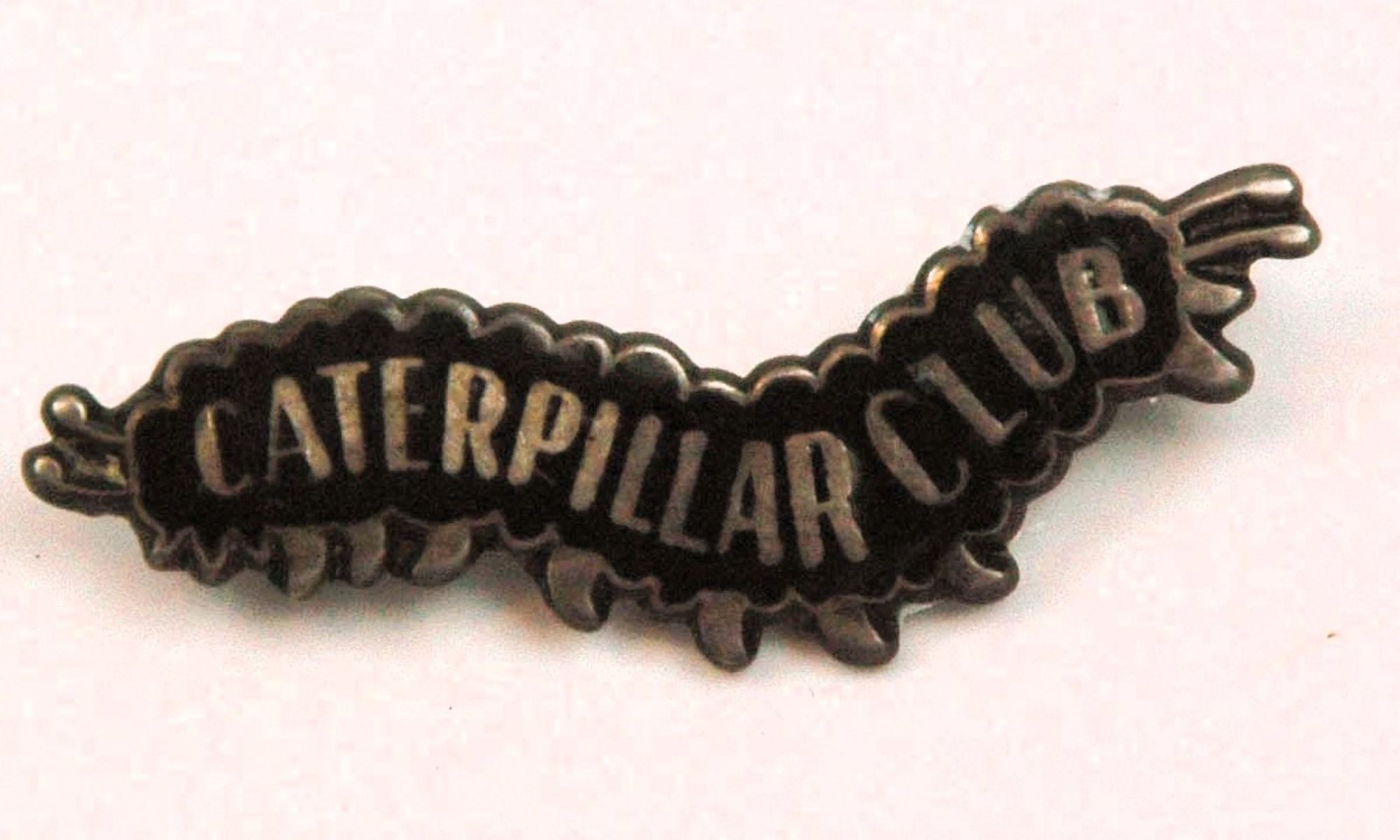
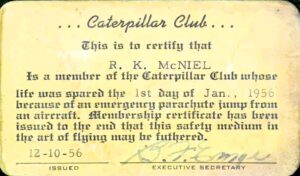
Successful applications for membership in both clubs, which sometimes came from behind the fences of prisoner of war camps, resulted in the receipt of a membership card and identifying device. In the case of the Caterpillar Club, it was a pin shaped like the club’s namesake, ruby eyes denoting a midair collision. New members of the Goldfish Club received an embroidered patch featuring a winged goldfish above two stripes on a black field. Additional stripes were awarded for subsequent rescues. Among those who sought membership was Lieutenant (junior grade) George H.W. Bush, his application dated December 27, 1944, following his bailout from a TBM Avenger during a strike against Chichi Jima the previous September.
While membership numbers have dwindled through the years, these unique clubs represent the camaraderie among those who face the inherent dangers of flight and survive.