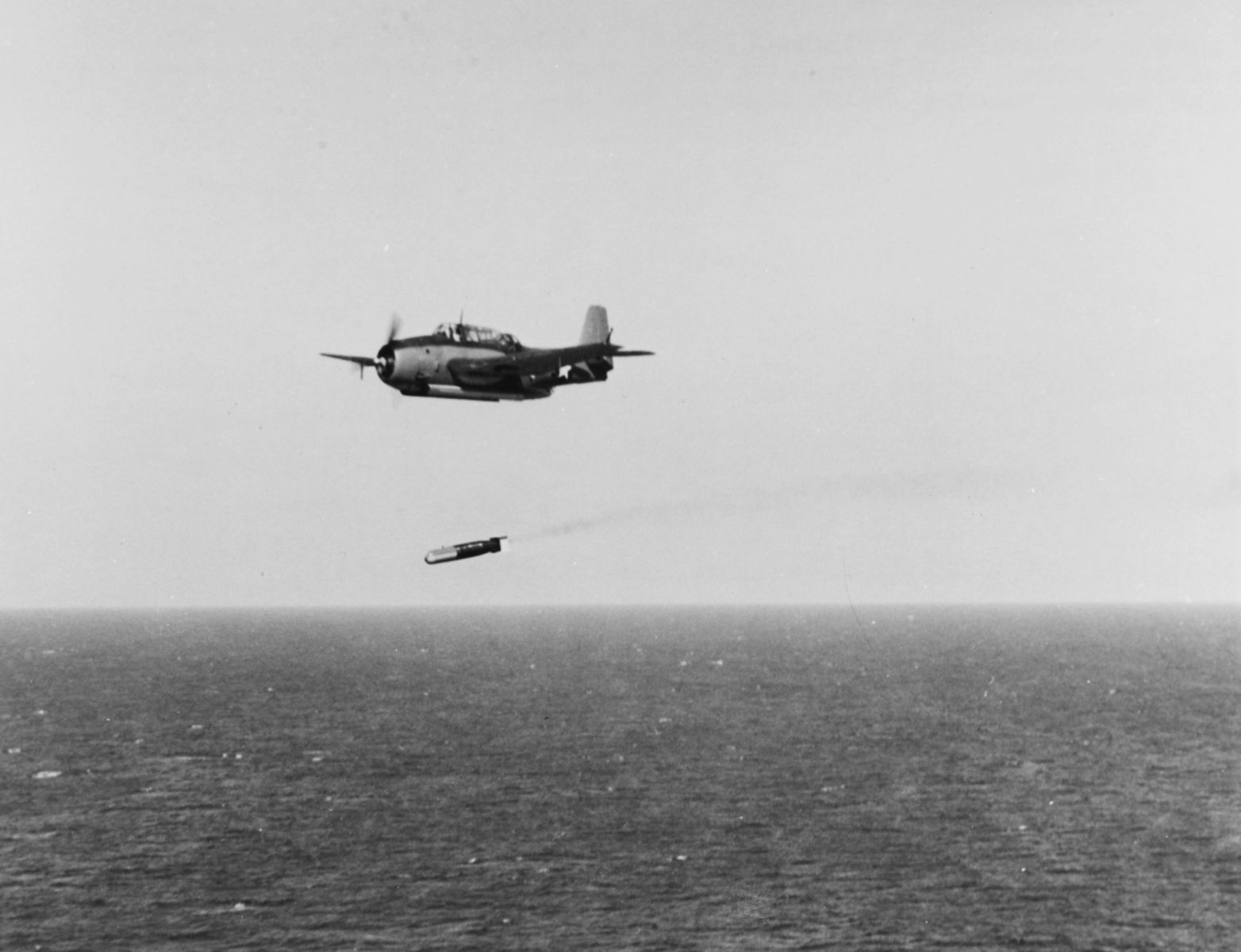
First Flight:
The prototype XTBF-1 made its maiden flight on August 1, 1941. Two months later, Secretary of the Navy Frank Knox approved a list of nicknames for aircraft in service or in production. The TBF received the nickname Avenger, which proved fitting given the fact that the first production airplane flew just weeks after the Japanese attack on Pearl Harbor.
Design:
While the airplane it was designed to replace, the TBD Devastator, had been revolutionary when introduced given it was the Navy’s first all-metal monoplane, by the time of World War II, it was outclassed in performance. The Avenger’s top speed bested that of the Devastator by nearly 100 M.P.H. and it also boasted greater range and a higher service ceiling. The Avenger also featured an internal bomb bay, a first for a carrier-based aircraft.
Inauspicious Beginnings:
The TBF experienced some growing pains, its initial flight trials revealing instability that required relocation of the engine and modification of the tail surfaces, to include the addition of a dorsal fin forward of the vertical stabilizer. One of the prototypes also crashed after the two crewmen bailed out after reporting an onboard fire.
Similarly, the airplane’s baptism of fire proved tragic. Six TBF-1s of Torpedo Squadron (VT) 8 were shore-based during the Battle of Midway. While the squadron’s carrier-based echelon flying TBDs from USS Hornet (CV 8) had only one survivor, Ensign George Gay, after its attack against the Japanese fleet on June 4, 1942, the Avenger crews also suffered tremendous losses. Only one of six airplanes returned from the mission against the enemy. Hit by shrapnel and with his airplane damaged, ENS Albert Earnest managed to make it back to Midway with one crewman dead and another wounded. He received two awards of the Navy Cross for this flight, one for executing his attack and the other for successfully bringing his airplane back to base.
A Turkey With Many Feathers: While the Avenger was designed as a torpedo bomber for use in fleet actions, as World War II progressed executing these type missions became less frequent. Instead, the “Turkey,” as the airplane was nicknamed unofficially, proved its versatility in carrying an array of ordnance in a variety of roles. Operating from escort carriers, Avengers helped turn the tide in the Battle of the Atlantic by employing bombs, depth charges, rockets and even homing torpedoes against German U-boats. The airplane was capable of dropping aerial mines to restrict the passage of enemy shipping and equipped with radar was a platform for pioneering night missions from carriers. It also helped pioneer airborne early warning, a mission it continued into the postwar era with a version of the airplane that featured a ventral radome. During the Korean War, Avengers served as the first carrier onboard delivery (COD) platforms.
Cars to Airplanes:
During World War II, America became known as the “Arsenal of Democracy” with many factories shifting to war production. Among the companies that turned to making weapons of war was automobile manufacturer General Motors (GM). Its Eastern Aircraft Division assumed production of both the F4F Wildcat and TBF Avenger, which allowed Grumman to focus on producing the F6F Hellcat. In the case of the Avenger, of the 9,838 aircraft produced, 7,546 of them rolled off GM assembly lines (these were designated TBMs).
The Museum’s Aircraft:
The museum’s TBM-3E (Bureau Number 53593) was delivered on June 7, 1945, serving briefly with Carrier Aircraft Service Unit (CASU) 12 and Torpedo Squadrons (VT) 19 and 26. In November 1946, the aircraft transferred to Naval Air Station (NAS) Norfolk, VA, beginning a period in which it also operated from NAS Banana River, FL, and NAS Atlantic City, NJ. It also served with Attack Squadron (VA) 1L during 1947-1948. It became part of the museum’s collection in 1981.