First Flight:
The first production SBD- 1 Dauntless made its maiden flight on May 1, 1940.
Slow But Deadly:
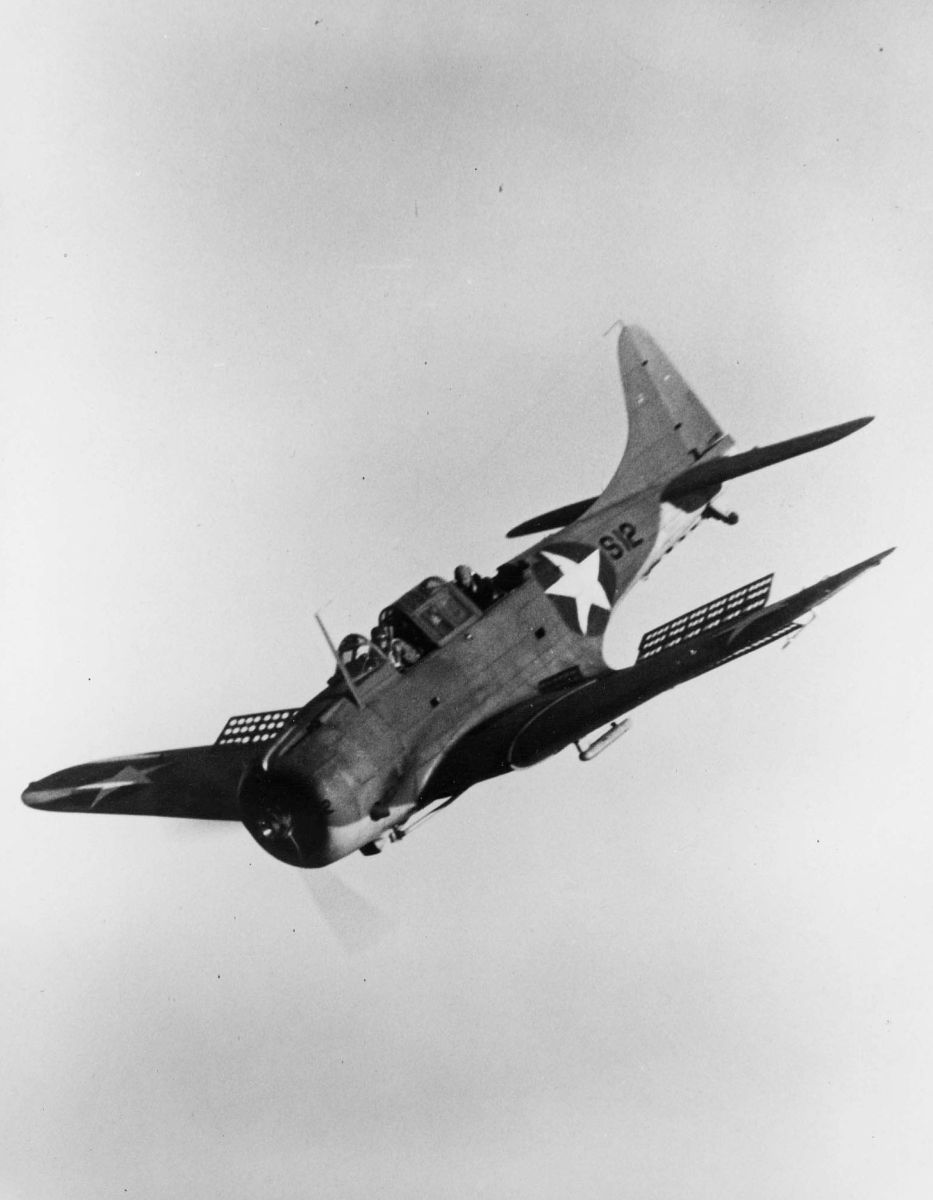
The SBD was not a particularly fast aircraft, the top speed of the version on display just over 250 M.P.H. However, when plummeting toward a target in a steep dive, it was at its most deadly. Its perforated dive flaps slowed and stabilized the airplane, allowing pilots to literally aim their bombs in dive bombing attacks that proved highly effective during World War II. This was particularly true at the Battle of Midway in June 1942, during which Dauntless aircrew were responsible for sinking all four Japanese carriers. Including Midway, SBDs participated in all five of the great carrier vs. carrier battles of World War II and formed an important element of the famed Cactus Air Force during the bitter battle for Guadalcanal. Their front-line service lasted throughout the entirety of the war, with land-based Marine Corps squadrons operating them after Navy carrier-based units replaced them aboard ship with the SB2C Helldiver. Douglas Aircraft Company delivered nearly 5,000 examples of the SBD to the Navy. The museum’s example is a SBD-2, of which 87 were constructed.
A Rare Bird :
The aircraft on display, SBD-2 (Bureau Number (BuN0) 2106), entered service with Bombing Squadron (VB) 2 on New Year’s Eve 1940, beginning a career that makes it one of the most historic combat aircraft anywhere in the world. While with VB-2, it was assigned to USS Lexington (CV 2), flying from that carrier in training exercises throughout much of 1941.
One stroke of luck amidst the tragic events of the Pearl Harbor attack on December 7, 1941, was that the Pacific Fleet’s aircraft carriers were not in port. Instead, they were returning to Hawaii after delivering Marine Corps squadrons to island outposts at Wake and Midway. In the case of Lexington, to make room for the Marine fighters, the ship offloaded some of its normally assigned aircraft complement, including BuNo 2106. Thus, this airplane was on Ford Island in the middle of Pearl Harbor when the Japanese attack occurred, surviving its first combat action.
Carrier operations in the first months of the Pacific war involved hit and run raids. On March 10, 1942, BuNo 2106 participated in an air strike against Japanese shipping at Lae and Salamaua, New Guinea. It was one of 103 aircraft from Lexington and USS Yorktown (CV 5) that flew over the Owen Stanley Mountains and attacked the enemy before retracing their path back to the ships. Lieutenant (junior grade) Mark T. Whittier flew the airplane with Aviation Radioman Second Class Forest Stanley as the gunner in the rear cockpit. This marked the airplane’s second combat action of World War II.
Battle of Midway:
When Lexington returned to Pearl Harbor following the raid at Lae and Salamaua, BuNo 2106 was again put ashore and earmarked for transfer to Marine Scout Bombing Squadron (VMSB) 241 on Midway Atoll, arriving there with 18 other SBD-2s on May 26, 1942, on board the aircraft transport USS Kitty Hawk (APV 1). Nine days later, on June 4, 1942, First Lieutenant Daniel Iverson, Jr., and Private First Class Wallace J. Reid manned the aircraft, embarking on a harrowing flight against the Japanese fleet in what would become known as the Battle of Midway. As Iverson’s action report noted:
From the time we began our approach, I observed fighters taking off the deck(s) of the enemy carriers … I observed Major Henderson [the squadron commanding officer] being attacked by enemy fighters … while approaching the target, but [he] kept the squadron intact until his plane seemed to go out of control about 2,000 feet. I selected a carrier target and peeled off through a thin cloud.
The carrier I hit was one of three that I saw … My bomb according to what I observed and my rear seat man said, hit just astern of the deck, a very close miss.
After observing my bomb explosion … I threaded away from the fleet on a course of 240 degrees. Two other fighters joined the fighters already pursuing me. The fighters pursued me, making overhead runs for twenty or thirty miles, when I was able to gain altitude and get into the clouds … My plane was hit several times … My throat [mic] cord was severed by a bullet and my hydraulic system was shot away … [I] had to land with one wheel up. My left wing was damaged in landing.
On the enemy carrier I observed almost an entire ring of fire from the flight deck. The fire appeared to be coming from the batteries of three-inch and machine guns.
I also recommend that my gunner, Wallace J. Reid, Pfc., USMC, be given a citation for bravery in action. He was injured in the foot.
Lost:
Returned to the United States, the BuNo 2106 was repaired and eventually assigned to the Carrier Qualification Training Unit (CQTU) at NAS Glenview, Illinois. On the morning of June 11, 1943, with Marine 2nd Lieutenant Donald A. Douglas, Jr., at the controls, the aircraft ditched in the waters of Lake Michigan during an errant approach to the training carrier USS Sable (IX 81). Douglas was retrieved from the water by a Coast Guard rescue boat, but his aircraft sank to the bottom of the lake.
Found:
Recovered in 1994, the aircraft underwent extensive restoration at the museum before being placed on public display in 2001. On hand was CAPT Mark T. Whittier, USN (Ret.), the daughter of Iverson, who was killed in a midair collision in 1944, and the sons of Reid, who was killed in action in Korea.