First Flight:
The prototype of the SB2U Vindicator made its maiden flight on January 4, 1936.
First of Its Kind:
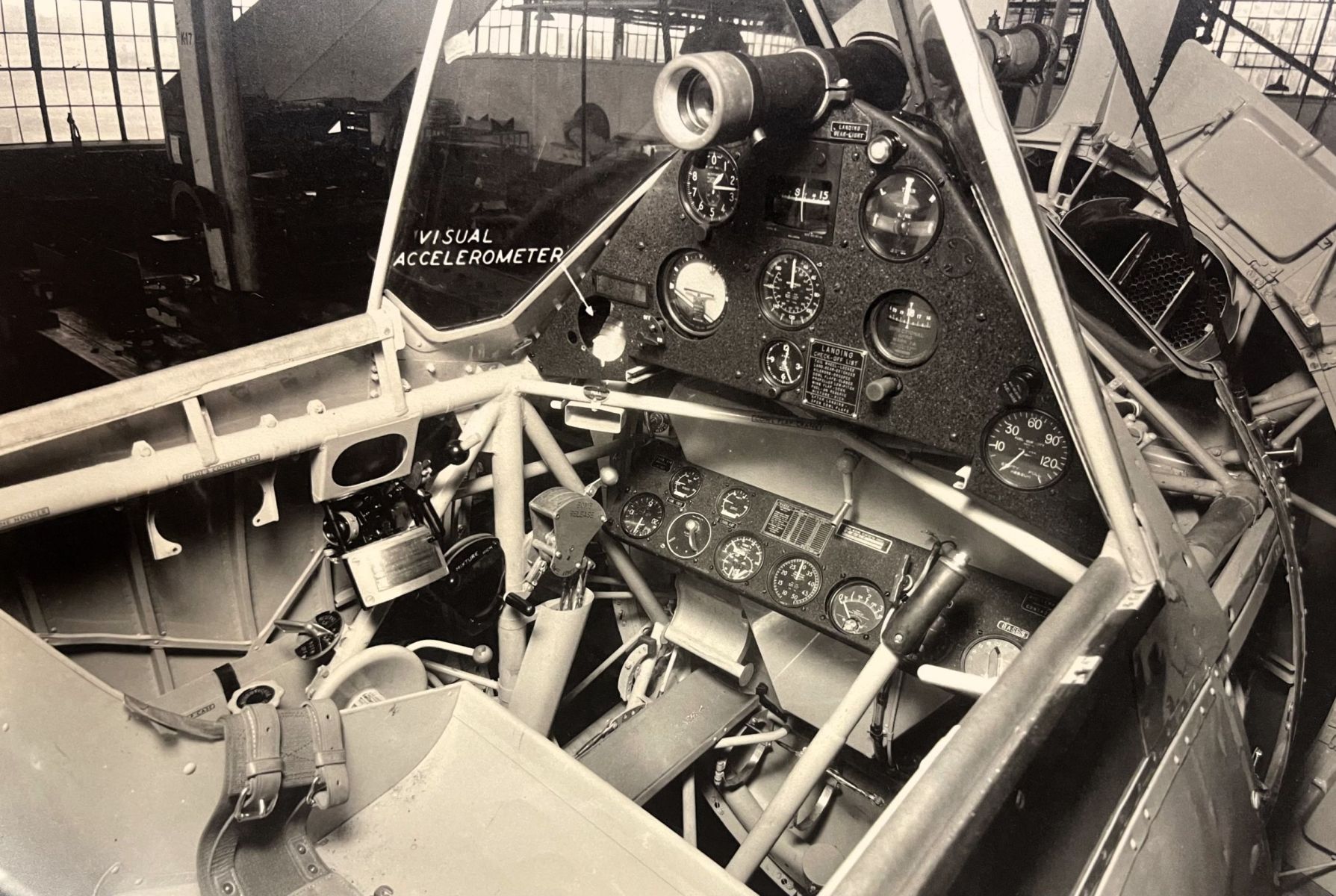
The SB2U represented a technological leap in Naval Aviation in that it was the Navy’s first monoplane scout-bomber. Without the struts and wires of a biplane creating drag, the airplane’s maximum speed eclipsed that of its predecessors by 45 M.P.H. However, though it had a metal framework, the Vindicator was predominantly covered in fabric. If it was placed in too steep a dive, the leading edges of the wings had a tendency to wrinkle. One remedy to slow the airplane down was to lower the landing gear.
Service:
Compared to the number of its successors delivered during World War II, the overall production of the SB2U was small. Across three variants of the airplane, Vought-Sikorsky produced just 169 production examples. The final version, and the one that differed most from the earlier SB2U-1, was the SB2U-3. It had increased fuel capacity and expanded armor for protection of the aircrew, which increased weight and diminished performance. This revealed itself in the only combat action for the SB2U-3, which occurred with Marine Scout Bombing Squadron (VMSB) 241 at the Battle of Midway in June 1942. Marine aircrew derisively called their aircraft “Wind Indicators” because their fragile construction allowed only shallow glide-bombing attacks against the Japanese fleet during the battle. This made the aircraft more susceptible to anti-aircraft fire and attacks by Japanese Zero fighters. Caption Richard Fleming received the Medal of Honor posthumously while flying a Vindicator at Midway, pressing home an attack against the Japanese cruiser Mikuma despite his airplane having been severely damaged by enemy fire.
The Museum’s Aircraft: The last SB2U-2 delivered to the Navy, the museum’s Vindicator entered service in 1939, and logged flights with four squadrons during its operational career. These included Bombing Squadron (VB) 4 and Scouting Squadron (VS) 41 on board USS Ranger (CV 4) and Fighting Squadron (VF) 71 on board USS Wasp (CV 7). Service in the former carrier in 1941 included support of the Neutrality Patrol, tracking hostile vessels approaching the shores of the United States. Equipping VB-9, a squadron destined for service on board USS Essex (CV 9), the museum’s SB2U-2 served to train squadron pilots on the deck of USS Charger (ACV 30). The aircraft then transferred to the Carrier Qualification Training Unit (CQTU) at Naval Air Station (NAS) Glenview, IL. On June 21, 1943, Marine Second Lieutenant A.W. Lemmons crashed over the side while attempting a carrier landing on board USS Wolverine (IX 64) operating in Lake Michigan. He was quickly rescued, but the airplane sank to the bottom, destined to remain there for 47 years.
Recovered in 1990, the relic that arrived in Pensacola bore the scars of nearly a half-century underwater, its fabric covering all but gone, many of its steel components rusted away, and what remained encrusted in marine growth.
It took 20,000 hours of restoration work to return the Vindicator to its former glory. Wherever possible, original components were treated and returned to the aircraft in their original condition, the marks of corrosion still visible in the form of holes and rough areas. Better than 90% of the aircraft, including the engine, which was restored inside and out, is original. The remainder consists of new or remanufactured parts that are as close to original specifications as is possible. The aircraft was placed on display in February 1999, and is displayed in the markings of VB-9.