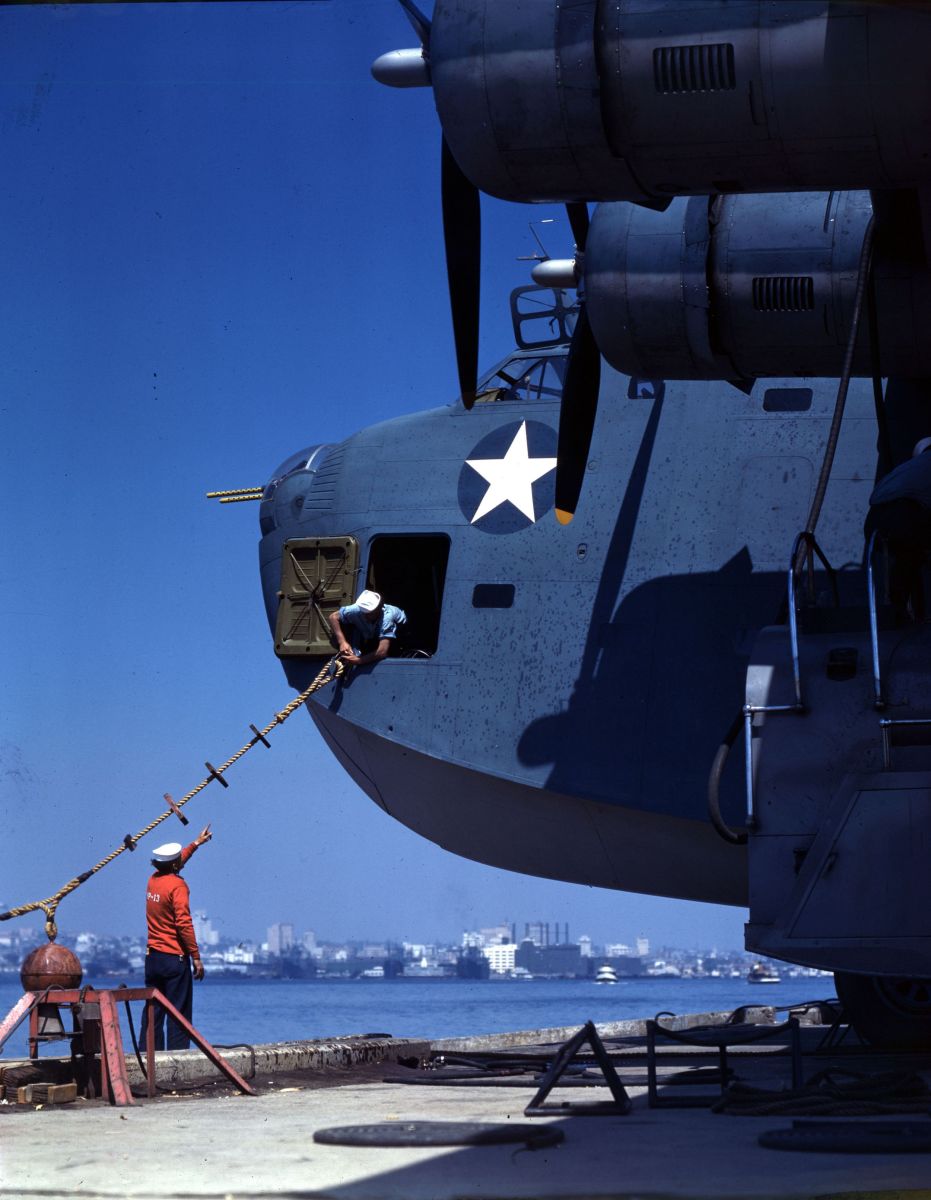
First Flight:
The prototype XPB2Y-1 Coronado made its maiden flight on December 17, 1937.
Design:
The initial design of the airplane featured a tall single vertical fin, but in final form the airplane incorporated twin tails. In addition, the Coronado was equipped with retractable wingtip floats designed for use on Consolidated Aircraft Corporation’s PBY Catalina flying boat. Interestingly, in later versions the inboard engines incorporated four-bladed propellers while the outboard engines featured three-bladed propellers. The former provided the aircraft more maneuverability and were reversible. They also generated more thrust and lift. The outboard three-bladed propellers weighed less and created reduced drag.
Roles and Missions:
The “PB” in the Coronado’s designation indicated that it was designed as a patrol bomber. Fitted with internal bomb bays in the wings, external hard points for ordnance and defensive machine guns, they were employed in antisubmarine warfare and in early 1944 executed a bombing attack against Japanese forces on Wake Atoll. They also carried out minelaying outside Truk Atoll. Primarily, the Coronado served in the transport role, including flying passengers as part of Naval Air Transport Service flights and medical evacuation of wounded personnel. A select number, including the example on display in the museum, were outfitted with plush interiors and employed as flag transports for senior officers. Interestingly, it was a PB2Y that transported Admiral Chester W, Nimitz to Pearl Harbor to assume command of the U.S. Pacific Fleet in the wake of the Japanese attack on December 7, 1941.
The Museum’s Aircraft: Delivered to the fleet on April 12, 1943, the museum’s PB2Y-5R Coronado (Bureau Number 7099) shuttled high-ranking officers back and forth between Hawaii and the West Coast. In August 1945 the aircraft and its crew flew to Guam, the forward headquarters for Fleet Admiral Chester W. Nimitz, the Commander in Chief, Pacific Fleet and Pacific Ocean Areas, and soon embarked Nimitz’s deputy, Rear Admiral Forrest P. Sherman, for the flight to Tokyo Bay to attend the formal surrender ceremonies ending World War II.
After participating in activities surrounding the surrender, the airplane was ordered to China to support the occupation of that nation. While there, it transported such notable flag officers as Admiral Thomas Kinkaid and Army Air Forces Lieutenant General George E. Stratemeyer. During this Chinese interlude, the Navy almost lost the seaplane in the Yellow Sea when heavy seas caused by a nearby typhoon punctured holes in the mammoth flying boat. Though the crew was able to patch them temporarily, they spent the next three days riding the swells and hoping the trusty Coronado would hold together. By the time the storm had passed, the airplane was a virtual wreck with loose rivets, water in the bilge, and paint stripped off. Flown back to the United States in November 1945, the aircraft was stricken from the Navy inventory in August 1946
A New Lease on Life:
Shortly after its retirement from naval service, the airplane attracted the attention of Howard Hughes, who likely saw in the Coronado an ideal platform to use in preparing for the flight of his famous “Spruce Goose.” For the next 27 years, the aircraft’s home was Long Beach, CA. Hughes maintained the Pacific veteran in flying status until the early-1960s, at which time the control surfaces and propellers were removed and placed in storage. It was donated to the museum in 1977 and has been completely restored. It is the only example of the PB2Y in existence.