First Flight:
The first of the Navy-Curtiss (NC) flying boats, the NC-1, made its maiden flight on October 4, 1918. The NC-4 first took to the air on May 1, 1919.
War and Peace:
As originally envisioned when designed during World War I, the NC boats were U-boat hunters that could fly across the Atlantic and be ready on arrival to conduct antisubmarine warfare in European waters. However, pioneer Naval Aviator Commander John H. Towers, who in 1914 had been involved in an effort to fly across the Atlantic Ocean, saw in the giant flying boat a platform for the nation and Navy to achieve the prestige of becoming first across, proposing the use of the NC boats for this purpose on October 31, 1918.
Design:
A joint venture by the Navy and the Curtiss Aeroplane and Motor Company, the NC flying boats were marvels of engineering for the time. The hull was relatively short (45 feet in length) and sturdy enough to withstand water landings. It supported biplane wings that at their longest point stretched a distance of 126 feet, longer than that of some modern airliners. Sturdy struts made of spruce supported the aircraft’s tail section. In a combat configuration, in which the NC boats did not operate because of the end of World War I, this enabled clearer fields of fire for machine gunners. In final form, three tractor engines (propellers facing forward) and one pusher engine (propeller facing aft) enabled a top speed of 85 M.P.H. Demonstrating the amazing technological advances in aviation, just 50 years after the NC boats reached this speed flying across the Atlantic, Neil Armstrong walked on the moon.
The Lame Duck:
On May 8, 1919, the NC-4 now displayed in the museum joined the NC-1 and NC-3 at NAS Rockaway Beach, Long Island, New York, for the first leg of the Navy’s transatlantic flight attempt. Under the overall command of Lieutenant Commander A.C. Read, the airplane experienced engine problems that necessitated a water landing off Massachusetts. The NC-4 taxied into NAS Chatham for repairs, falling behind the other aircraft as they made their way toward Nova Scotia and Newfoundland. The press began referring to the NC-4 as the “Lame Duck.” Ultimately, it was able to rejoin the other flying boats in time to launch on the longest and most demanding leg, a 13-hour flight over the North Atlantic from Newfoundland to the Azores Islands. Ironically, the NC-4 was the only one of the three aircraft to reach the Azores, the other flying boats making forced landings at sea. Eventually, Read and his crew reached Lisbon, Portugal, on May 27, 1919, completing the first successful transatlantic flight.
Recruiting Tour:
After returning to the United States via ship, the NC-4 was reassembled and displayed in New York City’s Central Park and then engaged in an extended recruiting tour between September 1919 and January 1920. The aircraft visited cities in 20 states along the East and Gulf Coasts and Mississippi River and its tributaries.
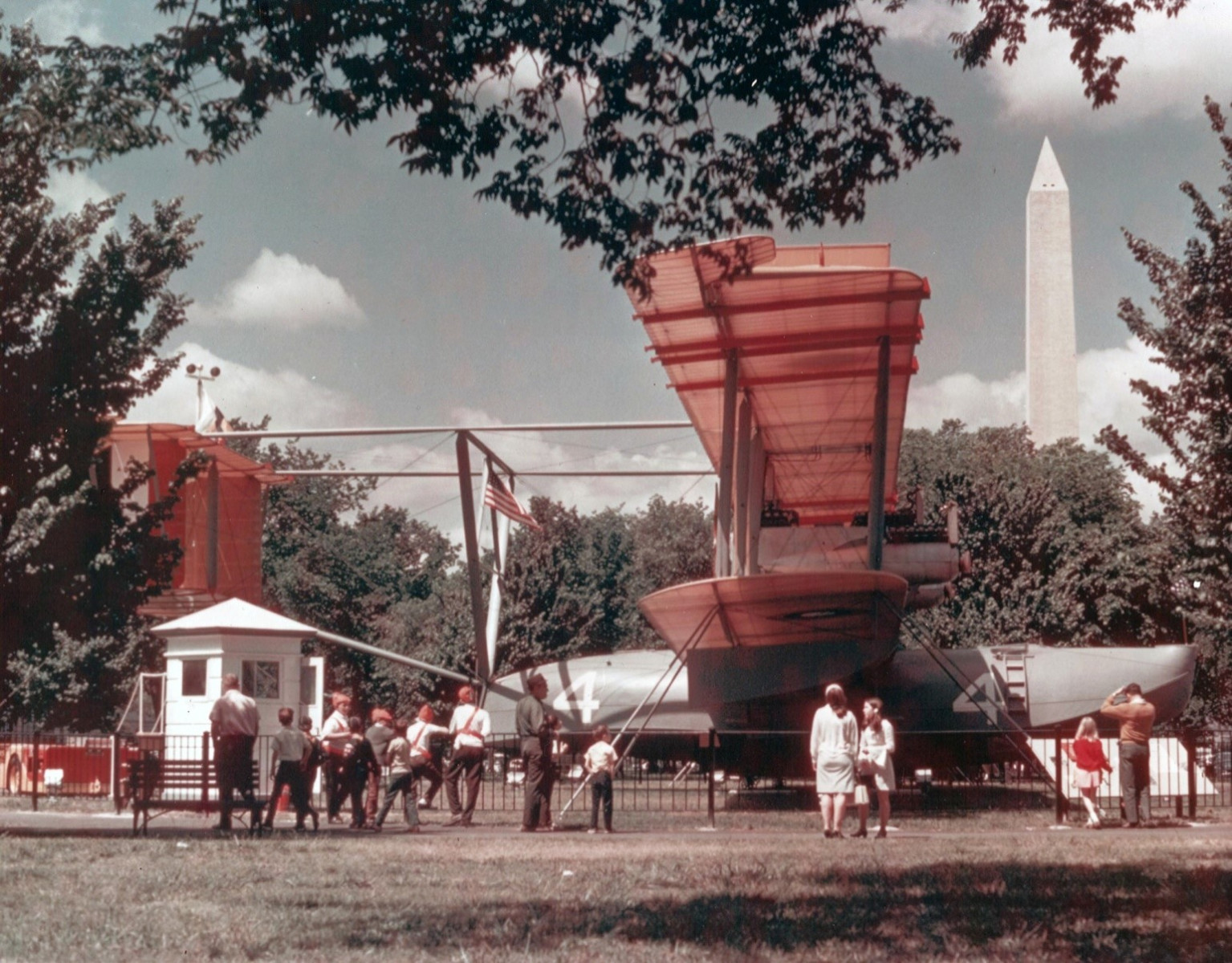
New Home: Except for a few occasions, the NC-4 went largely unseen until 1969, when the restored aircraft was displayed on the National Mall to commemorate the 50th anniversary of the flight. In 1974, the Smithsonian placed the aircraft on loan to the then-Naval Aviation Museum.