First Flight:
The earliest version of the Iroquois made its maiden flight on October 20, 1956.
Enduring Nickname:
The original designation of the helicopter as procured by the U.S. Army was HU-1, which inspired the nickname “Huey.” Few knew the helicopter by its official name Iroquois.
Versatility:
Though not fast, the earliest versions possessing a cruise speed of 115 M.P.H., the Huey was versatile and adapted to the shifting tactical demands of the Vietnam War. Capable of airlifting troops in its box-like fuselage, it proved an ideal platform for heliborne assaults supported by gunship versions of the type. Its small size made it ideal for landing in constricted areas or hovering overhead for expeditious evacuation of combat casualties, with Army, Navy and Marine Corps aircraft evacuating 378,000 casualties between 1965 and 1969
Variants: The Huey operated across the spectrum of the U.S. military and appeared in a number of versions. In Naval Aviation, it first operated with the Marine Corps, which began flying the UH-1E in 1964. The Navy procured the HH-1K and TH-1L for search and rescue and training duties respectively. The twin-engine UH-1N, which served with the Marine Corps in Operations Desert Storm and Iraqi Freedom among others, also equipped Antarctic Development Squadron (VXE) 6 supporting Operation Deep Freeze in the Antarctic. The latest in the long evolution of the Huey is the UH-1Y Venom.
The Seawolves:
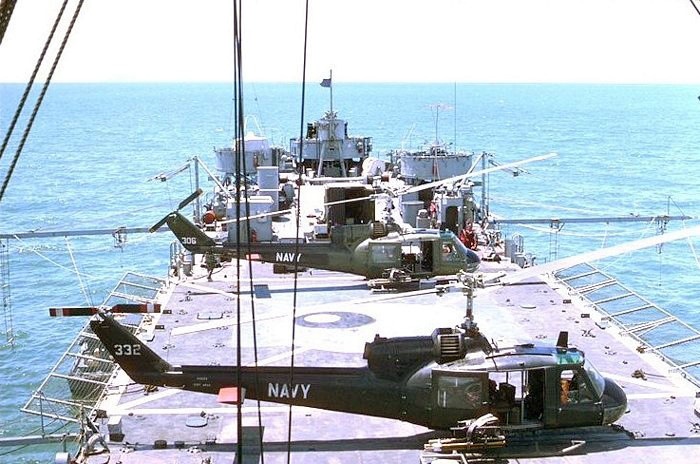
In 1967 the Huey was chosen to outfit Helicopter Attack Squadron Light (HA(L)) 3, the first squadron of its type in Naval Aviation history. Nicknamed the Seawolves, HA(L)-3 served in concert with Navy patrol boats interdicting the enemy in the waters of the Mekong Delta and also supported Special Operations Forces (SOF). The squadron’s helicopters were heavily armed, with machine guns, rockets, mini guns, and occasionally a 40mm grenade launcher. Able to scramble at a moment’s notice, Seawolves aircrew were heavily engaged. In one year alone, squadron personnel flew 34,746 hours, expending 17.5 million rounds of 7.62 mm /.50 caliber machine gun ammunition, 96,700 rockets, and 32,300 grenades.
The Museum’s Aircraft:
The museum’s UH-1B was originally delivered to the U.S. Army in October 1964 and the following year began flying combat missions in South Vietnam. Its two tours with the Army included being shot down by small arms fire, necessitating its return to the United States for repairs.
In 1968, the Army loaned it to HA(L)-3 and it operated with the Seawolves until returned to the Army in 1972, its time with the Navy squadron bringing its share of battle damage from enemy fire.
After logging 4,390 flight hours with the Army and Navy, the helicopter was placed in storage for 16 years at Davis-Monthan AFB. John Boucher purchased it with the intention of using it as a prop to blow up in action movies, the aircraft’s ties to the Seawolves convincing him to restore it to flyable condition.
Displayed through the generous support of the Seawolf Association, this UH-1B incorporates a typical HA(L)-3 weapons load, the mannequins wearing original Vietnam-era flight gear donated by veterans of the squadron.