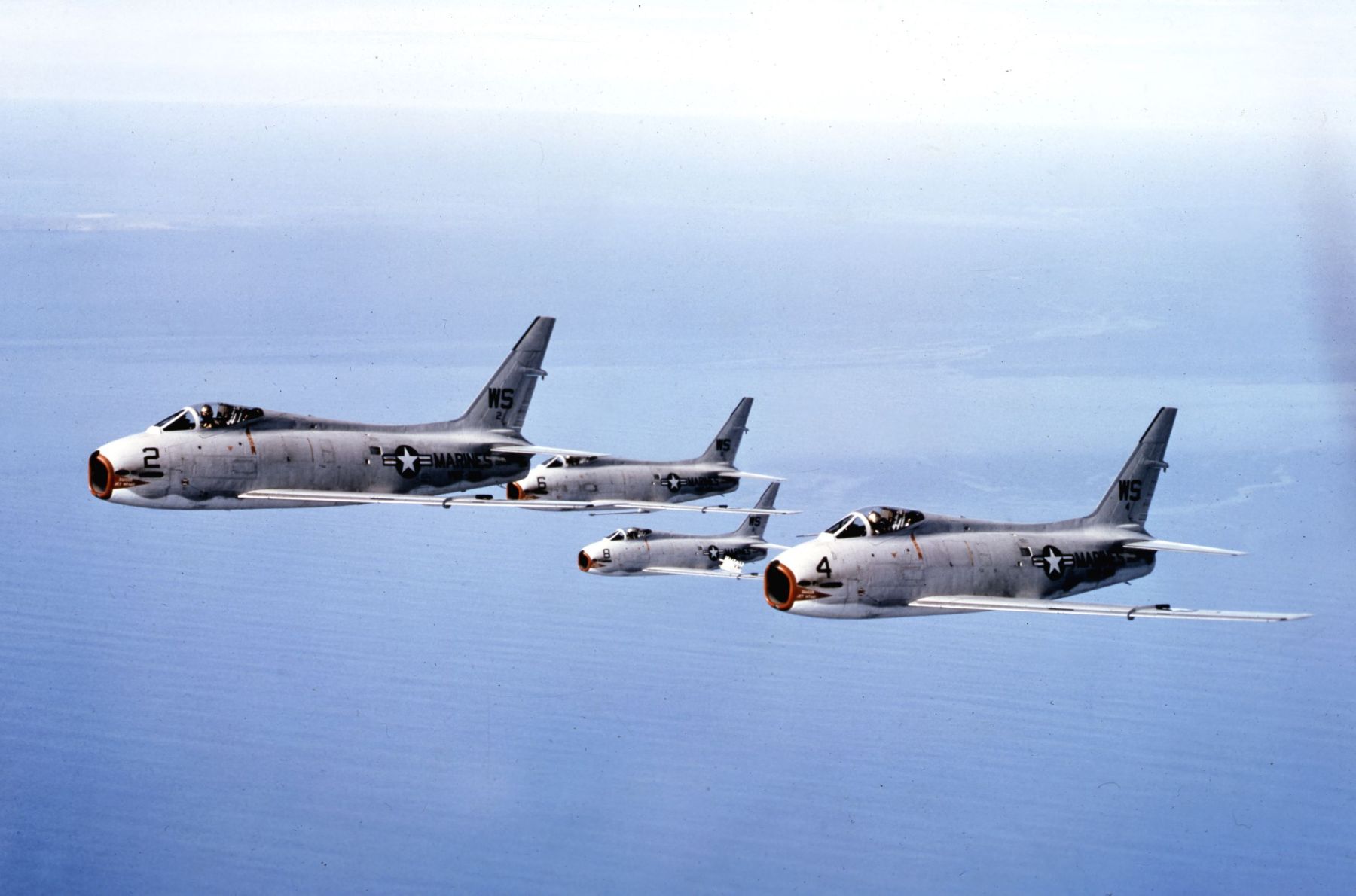
First Flight:
The FJ-4 Fury’s first flight occurred on October 28, 1954.
Same Look, New Airplane:
At first glance the FJ-4 resembled earlier swept-wing versions of the Fury that followed the straight-wing FJ-1 that took flight just after World War II. However, in many respects it was a different airplane. The FJ-4’s tails section and wings were thinner, the latter a “wet wing” capable of housing more fuel. The enlarged fuselage, which included a dorsal fairing behind the canopy, also provided increased fuel storage. Combined, the FJ-4 boasted 50 percent more fuel capacity over the FJ-3 that preceded it. Engineers also strengthened the undercarriage (landing gear) which enabled greater load carrying ability.
Performance:
The design modifications translated into excellent performance. A Wright J-65 -W-16A turbojet provided 7,700 pounds of thrust that enabled a maximum speed of 680 M.P.H. and a service ceiling of over 45,000 feet. One pilot recalled, “You wore the plane like a glove. Its maneuverability made it a fighter pilot’s dream.” Yet, it also handled well at low speeds in the carrier environment, in part because of a controllable drooping wing leading edge and its excellent engine response to the pilot’s throttle movements. The added fuel storage and aerial refueling capability provided extended range.
Service:
The FJ-4 entered service with Marine Fighter Squadron (VMF) 451. While the “straight” FJ-4’s primary arsenal was its 20 millimeter cannons and AIM-9 Sidewinder missiles, the follow-on FJ-4B boasted additional hard points that could carry conventional bombs, tactical nuclear weapons, and the Bullpup air-to-surface missile. FJ-4Bs deployed for the first time with the Bullpup in 1959, the pilot able to use a control stick and track two flares on the weapon to guide it into the target. Three Marine Corps and nine Navy squadrons flew this ground attack version.
Across the Pacific:
The robust load carrying capability of the FJ-4B included external fuel tanks, which along with aerial refueling capability made long-range flights possible. On October 8, 1958, as part of Operation Cannonball, two Marine FJ-4B-equipped squadrons landed at NAS Atsugi, Japan, after a transpacific flight from MCAS Kaneohe in the Hawaiian Islands. The Marines made the flight in two sections of 12 jets with layovers at Midway Island and Guam, and refueled from Air Force and Navy tankers.
The Museum’s Aircraft:
The aircraft on display entered service in November 1956 and is displayed in the markings of VMF-232, one of the squadrons in which it flew during its operational service. It arrived at the museum from its last duty station, NAS Glynco, GA, in 1964.