First Flight:
The prototype of the F4U-1 Corsair made its maiden flight on May 29, 1940.
Performance:
In 1938, when the Navy issued a requirement for a new carrier-based fighter, conventional wisdom stated that Navy aircraft, which had to be robust enough to withstand carrier landings, were not as capable in performance as their land-based counterparts. The Navy wanted that to change and in the F4U Corsair they received an aircraft of outstanding capabilities in both the air-to-air and air-to-ground arenas. Ironically, the aircraft initially did not operate aboard carriers because of a propensity for stalling at slow speeds and tendency to bounce on landing, which caused the tailhook to miss the arresting wires.
Design:
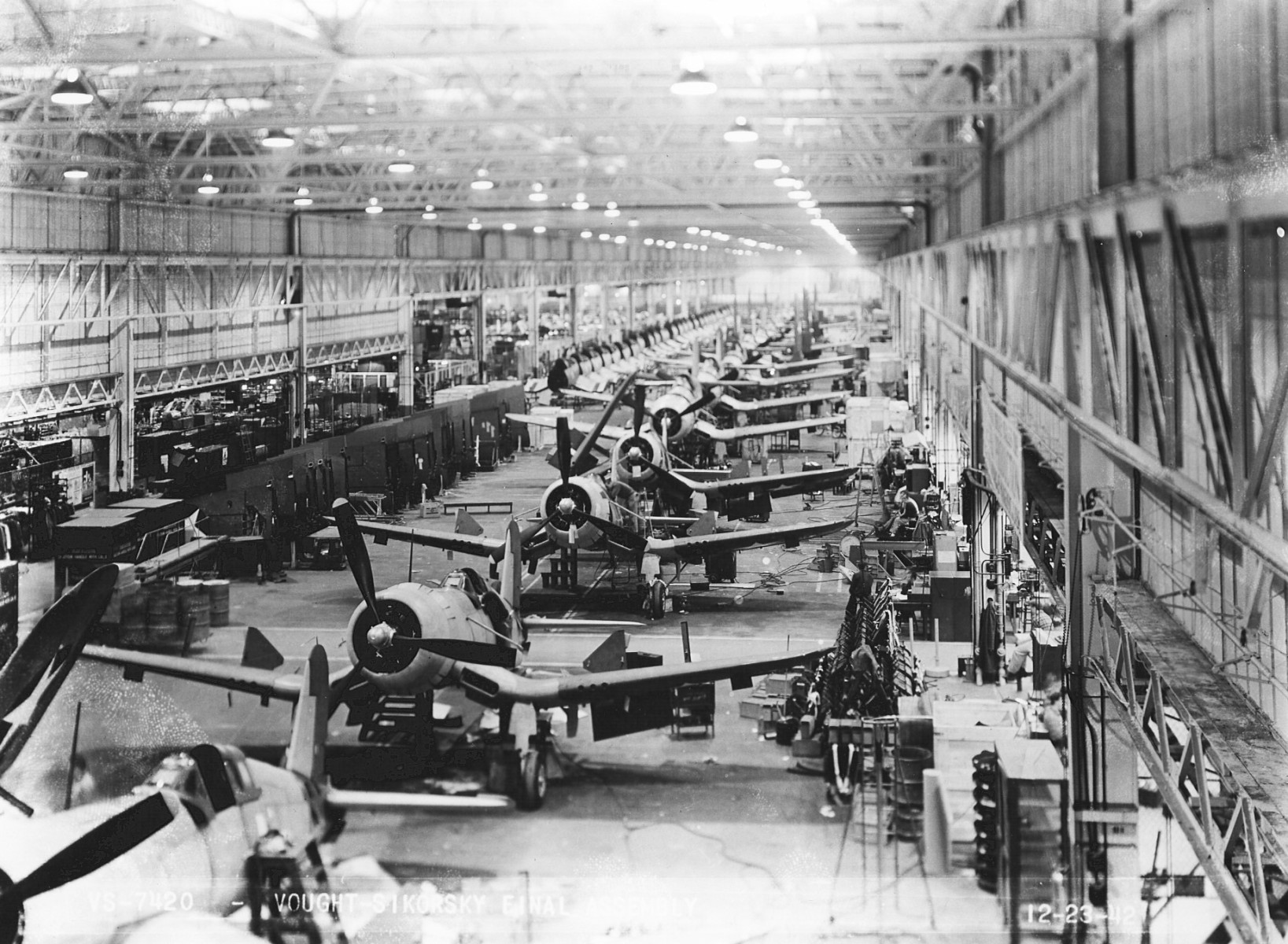
To achieve maximum speed – the aircraft would become the first single-engine fighter to eclipse 400 M.P.H. – Vought engineer Rex Beisel designed the Corsair around the powerful 2,000 horsepower Pratt & Whitney R-2800 engine. The propeller blades that stretched 13 feet in diameter necessitated what became the aircraft’s most distinctive feature, its inverted gull wing. The initial design of the cockpit canopy featured framed panels. Later F4U-1s and subsequent versions featured a “bubble” canopy that provided greater visibility. Those Corsairs with the original canopy, like the museum’s example, were known as “Birdcage” Corsairs.
Service:
The early F4U-1s equipped some of the most famous squadrons in Naval Aviation history. These included the Marine Fighting Squadron (VMF) 214 Black Sheep and the Fighting Squadron (VF) 17 Jolly Rogers. Medal of Honor recipient Major Gregory “Pappy” Boyington commanded the former squadron, which captured headlines for its combat exploits. The Jolly Rogers shot down 152 Japanese aircraft and produced 11 aces during their combat tours flying Corsairs. By war’s end, Corsairs had shot down 2,140 Japanese aircraft, achieving a kill-to-loss ratio of 11:1.
Nicknames:
The Corsair garnered a number of unofficial nicknames during its service. The aircraft’s inverted gull wings inspired “U-Bird,” while the sound the aircraft made in a dive prompted the Japanese to call the airplane “Whistling Death.” Marines on the ground in the final major campaign of World War II, who were the beneficiary of its close air support, called the airplane the “Sweetheart of Okinawa.” With the cockpit set far back on the fuselage, pilots called the aircraft the “Hose Nose” and “Hog.”
The Museum’s Aircraft:
The aircraft on display is one of only four surviving Birdcage Corsairs. It was number 312 of more than 11,000 F4Us (and Goodyear FG versions) built. On June 12, 1943, less than two months after its delivery to the Navy, the airplane crashed into Lake Michigan during carrier qualification on board USS Wolverine (IX 64). Recovered in 2010, it underwent an extensive restoration effort that was completed in 2024.