First Flight:
The first flight of the prototype of the F3F-2 occurred on July 27, 1936.
Bridge to the Cats:
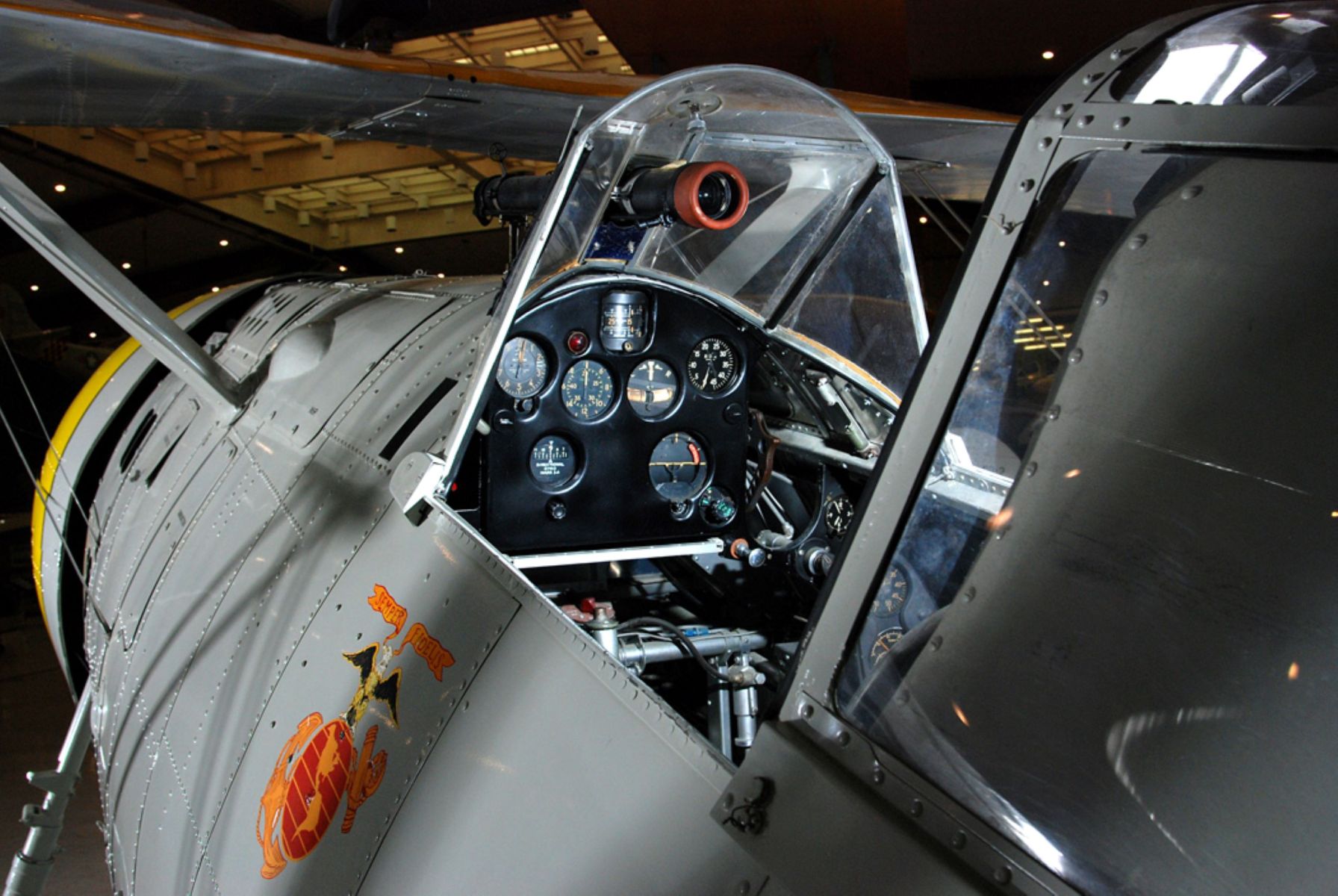
Grumman Aircraft Engineering Corporation’s F3F represented the last biplane fighter in front-line service in the Navy and a bridge to the first of Grumman’s “Cat” fighters that fought in World War II. The second of three versions of the F3F, the F3F-2 boasted a top speed of 260 M.P.H. and an increased fuel capacity that extended its maximum range compared to the F3F-1.
Marine Fighting Squadron 2:
Grumman delivered 81 production F3F-2s with some of them assigned to Marine Fighting Squadron (VMF) 2 in San Diego. This included the aircraft now on display in the museum, Bureau Number (BuNo) 0976, which arrived in the squadron in January 1938 following its delivery to the Marine Corps the previous year. Filling the ranks of this squadron were aviators destined for greatness in World War II, including Medal of Honor recipients First Lieutenants Henry T. Elrod and Robert E. Galer. BuNo 0976 spent over two years with this squadron, including its stint performing flying sequences for the movie Flight Command (though it isn’t known whether the aircraft flew for the cameras).
Lost:
On August 29, 1940, VMF-2 was in the midst of carrier qualification on board USS Saratoga (CV 3) operating off California. At the controls of BuNo 0976, First Lieutenant Robert E. Galer was in the downwind leg of his approach to the carrier. Following standard procedure, he shifted to his reserve fuel tank in preparation for landing, but much to his surprise the engine sputtered. He managed to keep the engine running for a short time longer with his wobble pump, but it soon quit, forcing him to make a water landing 300 yards astern of Saratoga. Though he was rescued, BuNo 0976 sank to the bottom of the Pacific.
Found:
In June 1988, while searching for a downed helicopter, a Navy deep submersible vehicle happened upon BuNo 0976 in near vertical position. The engine and cowling were buried in the ocean floor, but the aircraft’s fuselage was intact save for some slight damage to the wing area. On April 4, 1990, the Navy recovered the aircraft and returned it to NAS North Island, where Brigadier General Robert E. Galer, USMC (Ret.) awaited it. When asked by the station’s commanding officer whether he had taken off from North Island on that long ago day. Galer responded in the affirmative. The base commander responded, “After all these years I guess we can finally close out your flight plan.” The airplane was restored by the San Diego Aerospace Museum and arrived at the museum in 1994.