First Flight:
The D-558-1 Skystreak made its maiden flight on April 15, 1947.
A New Age Dawns:
While propeller-driven aircraft waged the air battles of World War II, the operational use of the Me 262 by the Luftwaffe and the development of early jet aircraft designs by the Allies pointed to the dawning of a new age in military aviation. To explore the bounds of high-speed flight the Navy’s Bureau of Aeronautics, the National Advisory Committee for Aeronautics and Douglas Aircraft Company worked together to develop the D-558-1 Skystreak, with the first design drawings delivered in April 1945.
Design:
The D-558-1 took off and landed under its own power generated by the 5,000-lb. static thrust Allison J35-A-11 engine housed in a cylindrical fuselage whose shape and color inspired the nickname Crimson Test Tube. One unique aspect of the airplane was the escape system for the pilot. In the event of an emergency, the nose detached from the fuselage and when it reached a safe speed, the pilot could perform a bailout through the detached end of the nose section. Because applicability to then-contemporary military combat aircraft was a development priority the Skystreak is otherwise of generally conventional, straight-wing design with a large air intake in the nose. Integral fuel tanks were located in the forward areas of the wings. Additional fuel could be carried in wing-tip tanks. As originally built the D-558-1 was fitted with a clear “bubble” canopy that was replaced in anticipation of high-speed tests with a hooded metal and glass canopy with a “V” shaped forward panel.
Record-Setter:
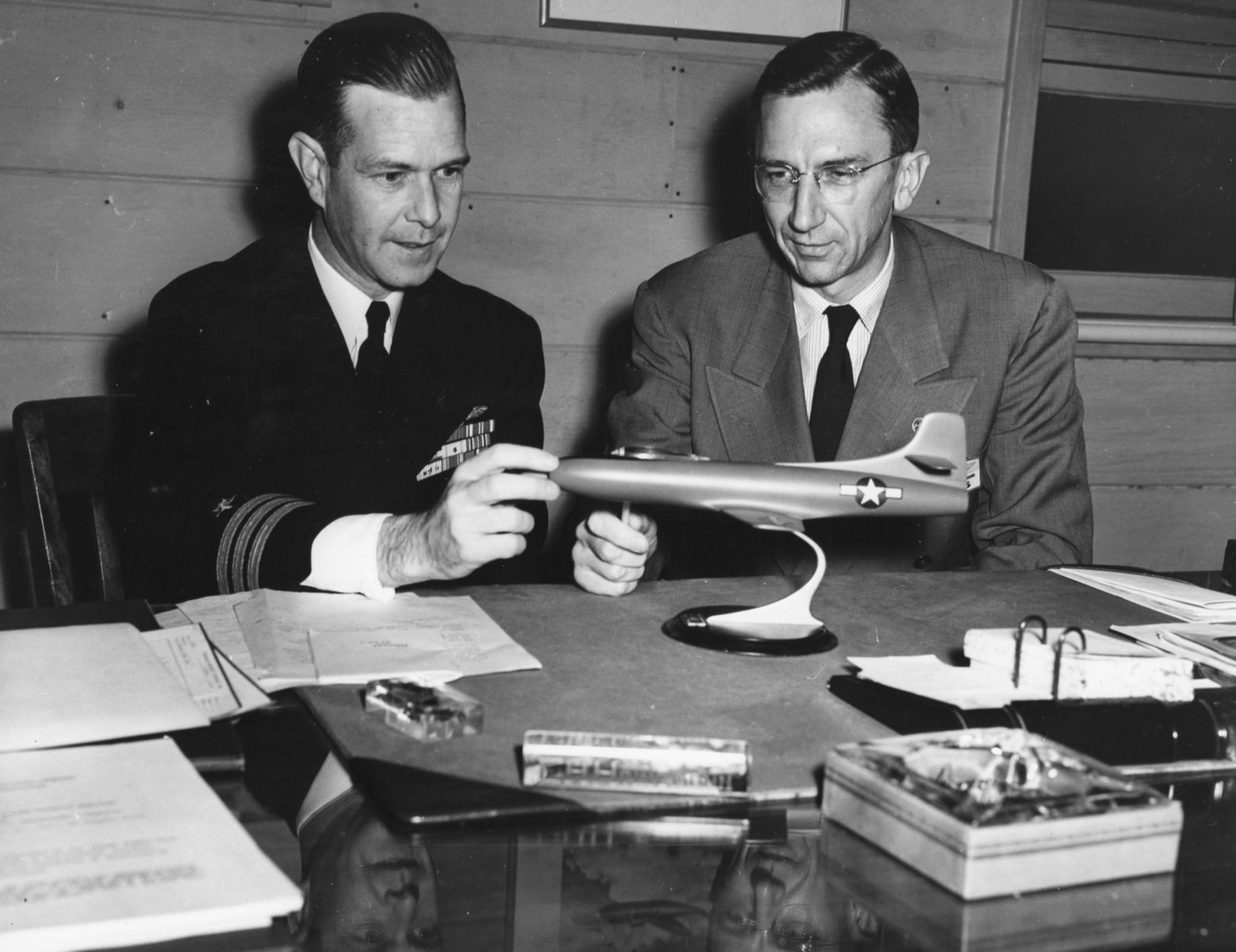
On August 20, 1947, Commander Turner F. Caldwell took off in the first D-558-1 (Bureau Number 37970), the airplane displayed at the museum, to top the speed record of 623.738 M.P.H. established a month earlier by Army Air Forces Colonel Albert Boyd in a P-80R Shooting Star modified for the flight. In four passes over the 3-kilometer course at Muroc Army Airfield, Caldwell averaged a speed of 640.743 M.P.H., shattering Boyd’s mark. According to newspaper accounts of the era, Caldwell made his turns at the end of his four runs as tightly as possible to conserve fuel, using a black stripe on the ground and two clouds of green smoke marking the beginning and end of the 3-kilometer distance. His altitude was 75 feet. It marked the first time the Navy held the world speed record since Lieutenant Al Williams attained 266.59 M.P.H. in 1923.
Caldwell could rest on his laurels for just five days. On August 25, 1947, wearing the traditional cloth flight helmet because the height of a hard hat would preclude his tall frame from fitting in the cockpit, Marine Lieutenant Colonel Marion Carl climbed into the second Skystreak (Bureau Number 37971). Describing the airplane as the “blood-red Douglas Skystreak,” a newspaper article announced, “Plane Zooms Ahead of Sun,” in describing Carl’s flight that day, reflecting the fact that with his average speed of 650.6 M.P.H., he would have had to set his watch back a few minutes if flying from Berlin to London.
The D-558-1 held the mantle of fastest aircraft in the world for just a brief time. The X-1, flown by Air Force Captain Chuck Yeager, became the first airplane to break the sound barrier on October 14, 1947.
The Museum’s Aircraft:
After completing 101 flights, including Caldwell’s record-setting one, the museum’s D-558-1 (the first of three built) retired from service. It became part of the museum collection in 1964.