First Flight:
The B-25 Mitchell made its maiden flight on August 19, 1940.
Legacy of a Name:
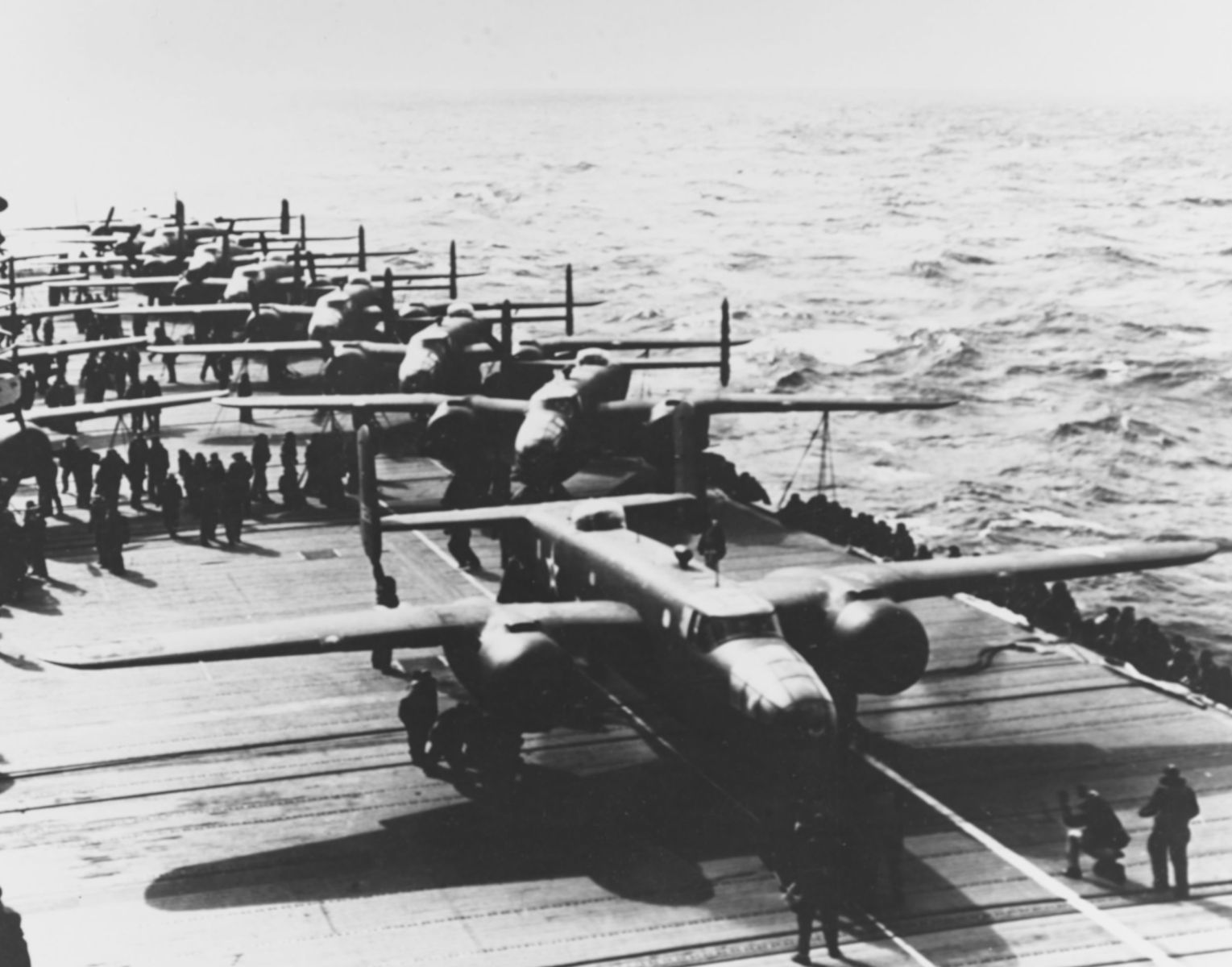
The B-25’s nickname was unique in that it honored a person, Colonel William “Billy” Mitchell, an early proponent of strategic bombing who famously carried out bombing tests against naval vessels to great acclaim in the press. Ironically, the most famous mission ever flown by the bomber that bore his name was launched from a U.S. Navy aircraft carrier.
Worldwide Service:
North American Aviation delivered nearly 11,000 B-25s in various versions between 1940 and 1945. The medium bomber, which could carry up to 3,000 pounds of ordnance, served in every theater of war in the air forces of multiple nations in addition to the United States, including the Soviet Union, Great Britain, the Netherlands, China, and Australia. One of the notable pilots who flew the type was Paul “Pappy” Gunn, a former Navy enlisted pilot, who obtained a wartime commission in the Army Air Forces. Flying in the Pacific Theater, he fitted B-25s with multiple machine guns to carry out low-level strafing attacks with great success against Japanese airfields and shipping, notably at the Battle of the Bismarck Sea in 1943.
The Doolittle Raid:
The most famous mission flown by the B-25 occurred in April 1942 when 16 bombers under the command of Lieutenant Colonel James H, Doolittle launched from USS Hornet (CV 8) to attack targets in the Japanese Home Islands. A Navy flight instructor, Lieutenant Henry Miller, trained the Doolittle Raiders to launch from an aircraft carrier. While the raid on Tokyo caused minimal material damage, it had an impactful psychological effect on the Japanese and boosted the morale of the American public starved for good news from the war front. For his actions leading the raid, Doolittle received the Medal of Honor.
Marine Corps Service:
A naval version of the B-25 operated with Marine Corps squadrons during World War II. Deliveries of this version, designated the PBJ, began in February 1943 and the type equipped a number of Marine bombing squadrons (VMB) in the Pacific. Modifications included increased armament in the nose for low-level attack and equipping the aircraft with radar for night missions.
The Museum’s Aircraft:
The aircraft on display was delivered to the Army Air Forces on August 24, 1944, and spent its entire operational career as a training and administrative support aircraft. Stricken from the U.S. Air Force inventory in 1958, the airplane subsequently served the Venezuelan government for decades, including fighting forest fires, before acquisition by private owners for restoration. Acquired by the museum in 1998, the airplane was initially painted as a PBJ. Following damage in Hurricane Ivan, it was restored in the markings of Jimmy Doolittle’s B-25B.