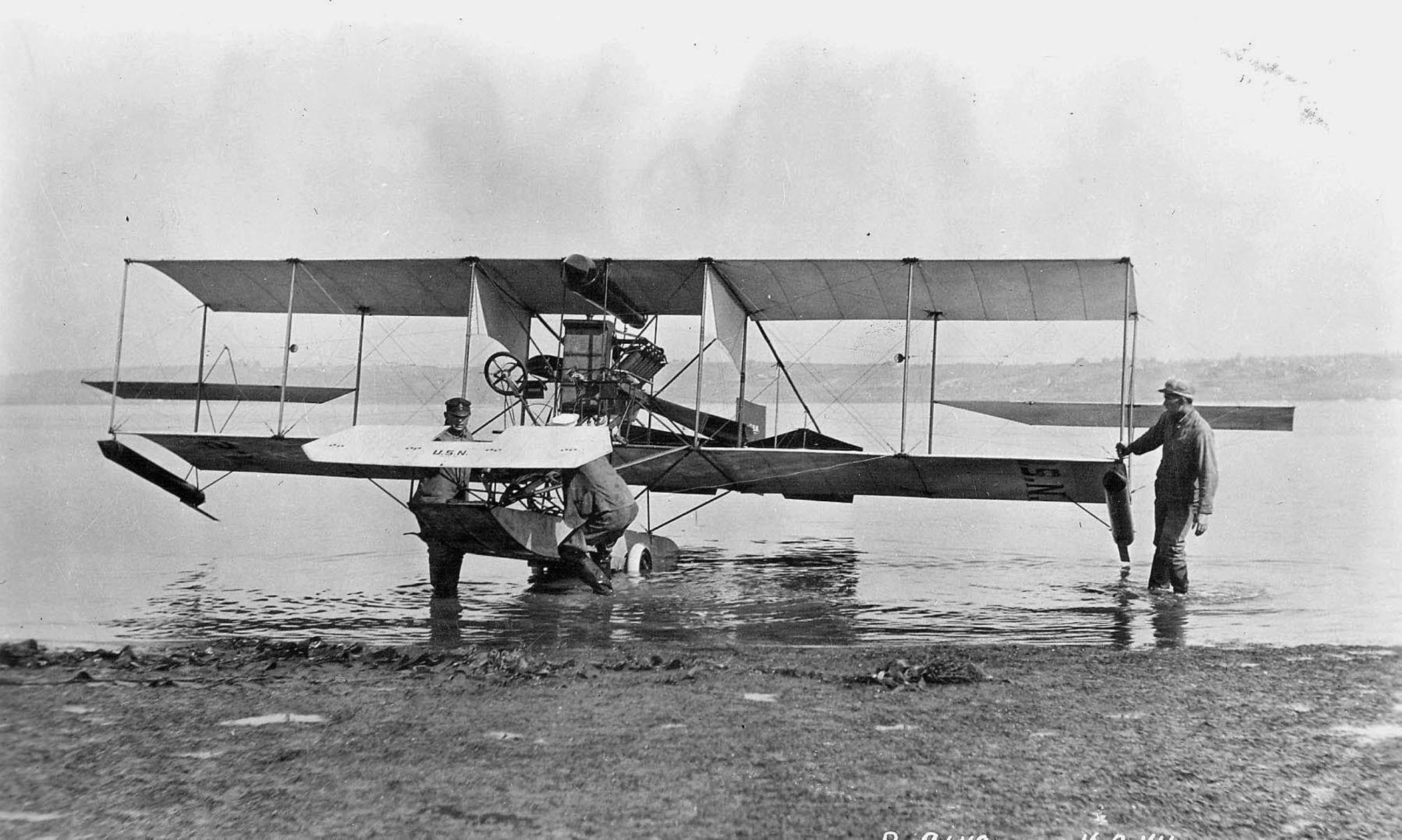
First Aircraft:
On May 8, 1911, Captain Washington Irving Chambers prepared requisitions for the purchase of the Navy’s first aircraft. One, which was designated the A-1 (later AH-1) Triad, was to be equipped for arising from or alighting on land or water and have a speed of at least 45 miles per hour. Chambers also called for the design to have provisions for carrying a passenger alongside the pilot with controls that either could operate.
Hydroaeroplane vs. Landplane:
Civilian pilot Eugene Ely performed landmark operations using a wheeled aircraft to take off and land on wooden decks on board cruisers in November 1910 and January 1911. However, the future of aviation operations with the fleet initially lay with hydroaeroplanes that could be carried aboard ships and operate from the water. The A-1 had the capability to operate from land and water along with the third dimension of the air, hence, the name Triad.
First Demonstration:
On July 1, 1911, Glenn Curtiss demonstrated the A-1, taking off from Lake Keuka in Hammondsport, NY, on a five-minute flight that reached an altitude of 25 feet. The aircraft completed three other flights the same evening, one by Curtiss with Lieutenant Theodore G. Ellyson, the Navy’s first aviator, as a passenger, and two by Ellyson alone. In the longest of these flights Ellyson was in the air for 15 minutes and achieved an altitude of 300 feet.
Test Bed:
The A-1 filled a training requirement, with Lieuteanants Theodore G. Ellyson and John H. Towers, learning to fly beneath its wings. However, as would be expected of the Navy’s first aircraft, the Triad was the platform for early experiments, including making the first night water landing without the benefit of landing lights, serving to test airborne wireless communication, and performing a cross-country flight covering a distance of 112 miles in 122 minutes. It also participated in early catapult trials, though both Ellyson and the aircraft plunked into the Severn River during a firing of a compressed air catapult on July 31 1912. It proved but one of many minor accidents encountered during the airplane’s service, but the A-1’s luck eventually ran out. After 285 flights and numerous rebuilds, it was damaged beyond repair in a crash on October 6, 1912.
The Museum’s Aircraft:
In commemoration of the fiftieth anniversary of U.S. Naval Aviation in 1961, the Navy joined with the Institute of Aerospace Sciences in San Diego to construct two exact replicas of the Curtiss A-1 Triad, one of which was flyable. The one not built to fly was donated to the Smithsonian National Air Museum (now National Air and Space Museum) while the flying replica remained in California for display in the San Diego Aerospace Museum. It was lost in a fire at the museum in 1978. The Smithsonian’s A-1 first arrived at NAS Pensacola, Florida, for display at the Naval Aviation Museum (now National Naval Aviation Museum) in 1968. It remained on loan until 1992, at which time custody was transferred to the museum.